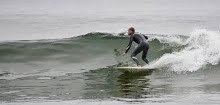
And so do I. I'm not sure why. I promised myself that when my new novella was finished (It is done, and I'm quite pleased with it) I would take the rest of the year off from any serious new writing. That's a funny turn of phrase, take the rest of the year off. Like this is my job, writing. If it was I would starve; not for a lack of quality, only a dearth of paying readers. Water everywhere. . . But writing is not my job. It's an exhausting passion. Half a year away from everything but this blog, my surf journal, and a few odd bits of verse doesn't sound too bad at all.
There's just one problem: I've already started a new project, a relatively ambitious one, if ambition and hubris can lay claim to being cousins. Worse than that, I'm enjoying the work. The research, the planning, the small, imperfect passages I've already committed to paper and to memory. All of it. Never, Dear Reader, never trust in the promise of a writer. That's true in so many ways, isn't it?
Thursday, May 6, 2010


Tuesday, April 27, 2010
A Personal History of the World
I'm a writer. I write fiction. That is to say, I make stuff up and slap it onto a page. If it's good, and if I'm lucky, a few people will read it and some of them will come up to me, or call me, or drop me a line and say, "Hey, that stuff was pretty good. I like your style, kid." It happens sometimes.
It's nice to have an audience, wonderful really, but it isn't the main reason I write. See, I'm foolish enough to believe that I'm actually creating something besides "content". I call it my personal history of the world, an imaginative appendix to reality. Inside my head it's nothing but potential; a swirl of chaos, invention, and intent, but once it hits the page it's fixed. Solid. It exists, and the more people who read it the more imaginatively real it becomes.
Whoah.
It all sounds so serious, doesn't it? I suppose it could be, if this was someone else's show, but I'm the demiurge atop this particular sub-creation and in my world serious is trumped by strange. In my world, the Devil plays poker in a cheap motel room with a redneck prophet who just happens to have the bones of the baby Jesus in the trunk of his car. In my world, a dying Edgar Allan Poe is the focus of a bizarre pilgrimage, while in a distant time in faraway Japan, a heartless bandit is sheltered from his pursuers by a beautiful trio of foxes. It's a world of war, in which a young man is afflicted by the hideous ghost of his brother and troubled by the unhappy inheritance of a gentle heart. A world where the heroes of the Trojan War reenact their eternal drama with bullets and blood on dirty, crime-ridden streets.
My world is serious, it's silly, it's real and surreal. Sometimes it's poetic and many times it's vulgar. It's countless different things, but it's one world and it's mine. I'm its historian and I'm happy to share it with you. I have a lot of work ahead of me.

It's nice to have an audience, wonderful really, but it isn't the main reason I write. See, I'm foolish enough to believe that I'm actually creating something besides "content". I call it my personal history of the world, an imaginative appendix to reality. Inside my head it's nothing but potential; a swirl of chaos, invention, and intent, but once it hits the page it's fixed. Solid. It exists, and the more people who read it the more imaginatively real it becomes.
Whoah.
It all sounds so serious, doesn't it? I suppose it could be, if this was someone else's show, but I'm the demiurge atop this particular sub-creation and in my world serious is trumped by strange. In my world, the Devil plays poker in a cheap motel room with a redneck prophet who just happens to have the bones of the baby Jesus in the trunk of his car. In my world, a dying Edgar Allan Poe is the focus of a bizarre pilgrimage, while in a distant time in faraway Japan, a heartless bandit is sheltered from his pursuers by a beautiful trio of foxes. It's a world of war, in which a young man is afflicted by the hideous ghost of his brother and troubled by the unhappy inheritance of a gentle heart. A world where the heroes of the Trojan War reenact their eternal drama with bullets and blood on dirty, crime-ridden streets.
My world is serious, it's silly, it's real and surreal. Sometimes it's poetic and many times it's vulgar. It's countless different things, but it's one world and it's mine. I'm its historian and I'm happy to share it with you. I have a lot of work ahead of me.

Monday, April 19, 2010
Clockwork Betty
Here's a tiny piece of fiction I whipped up and sent to Matchbook Story. Homeboy didn't want it, so I figured I'd put it up here. I also received a pretty funny rejection via email (It was serious, but I thought it was funny). Unfortunately, I deleted it. This version is longer than the one I sent (300 characters apparently includes spaces) and is a re-imagining of a longer short story I wrote a few years ago. Hope you enjoy it.
Clockwork Betty
Two cops found her wandering naked in an old industrial park, no I.D., a serial number stamped in crematory ink on the small of her wrist: BETAy2k10. They covered her in a blanket and gave her a pen, hoping she could write, but ones and zeros were all they got, and her lids snapping up and down like shutters over her liquid crystal eyes.

Clockwork Betty
Two cops found her wandering naked in an old industrial park, no I.D., a serial number stamped in crematory ink on the small of her wrist: BETAy2k10. They covered her in a blanket and gave her a pen, hoping she could write, but ones and zeros were all they got, and her lids snapping up and down like shutters over her liquid crystal eyes.

Wednesday, April 14, 2010
Writer, Be Stoked

This is what stoked me out as a writer- an oil
painting of the main character, Watanabe
Kenjiro, from my book Ghost of Iga. It was
painted by my friend Jason Cheeseman-
Meyer, and if you want to stoke him out,
you'll go to his website and check out his
work.
If you're a surfer, then you know in your gut what being stoked is. You also know what an ephemeral experience it can be and how stubbornly it defies quantification. If you don't surf and you don't know, then I'll try and lay it on you: Stoke is an aggregate emotion consisting of a sense of mental connection and technical accomplishment, fused with unbridled joy and a certainty that what you've just done and what you may yet do are completely worthwhile, for the simple reason that you are doing it. There is no formula for stoke, unless it's You get what you give. If you don't meet it halfway, it'll ditch your ass in a hot second.
Believe me, I've surfed well in what some would call perfect conditions and had a miserable time. No stoke at all. And I've surfed knee-high slop with my friends and left the water beaming. I've also seen some really great surfers who sit in the lineup looking like they just drank the water out of a sewer pipe, and who nail every wave they want and never once smile. Of course, the reverse of all this is true as well. You get what you give.
So what does this have to do with writing? Everything. As writers, we all have a set of ideal conditions and a list of goals in our mind- money, fame, a sweet publishing deal, critical recognition, wide readership, whatever. Maybe they happen, maybe they don't. The few I listed are long shots for most writers- That's just how it is. However it turns out though, you should constantly seek a reason to be stoked. Otherwise, you should probably be doing something else.
Sunday, April 4, 2010
A Writer's Reverie, or Why I Won't Quit My Day Job
I don't really remember when it happened- It was quite some time ago- but there came a point in my writing life when I quit asking Why am I doing this? and started asking myself How am I going to keep doing this? The answer turned out to be Any damned way I can.
First off, let me just say that I hate manuscripts. They look like crap, they feel like crap, and the words trapped inside their barren pages hate them as much as I do. A story in manuscript form is like a bird in a chicken-wire cage: You should kill it and eat it or else set it free. I released mine into chapbooks and gave them to my friends.
Back then, fifteen years or so, it was just me, a sturdy little tank of a laptop computer, an inkjet printer and a bootlegged copy of Wordperfect. A ream of printer paper, a ream of cardstock, and a big-ass stapler. I was in love.
Things are different now.
For one thing, I'm a better writer than I was back then. Quite good actually, thank you very much. I haven't done a chapbook in a while either, though I've kept copies of most of the old ones, and I still have that big-ass stapler. Nowadays I have the internet. I upload files to create print on demand paperbacks. I create paperless PDF's that I've been giving away for free. I keep this blog and I find my way onto twitter and facebook when I can.
But the biggest difference? Back when I was making those chapbooks I used to think that it would be great to be picked up by a "real" commercial publisher. Now, I know that what I really wanted was to be able to play with their toys and dig in their sandbox. I've come to realize that I'm just not terribly interested in writing as a business. I'm not a merchant, I'm not a brand, and I'm not a commodity. And I'm still too in love with my own vision to have it any other way.
First off, let me just say that I hate manuscripts. They look like crap, they feel like crap, and the words trapped inside their barren pages hate them as much as I do. A story in manuscript form is like a bird in a chicken-wire cage: You should kill it and eat it or else set it free. I released mine into chapbooks and gave them to my friends.
Back then, fifteen years or so, it was just me, a sturdy little tank of a laptop computer, an inkjet printer and a bootlegged copy of Wordperfect. A ream of printer paper, a ream of cardstock, and a big-ass stapler. I was in love.
Things are different now.
For one thing, I'm a better writer than I was back then. Quite good actually, thank you very much. I haven't done a chapbook in a while either, though I've kept copies of most of the old ones, and I still have that big-ass stapler. Nowadays I have the internet. I upload files to create print on demand paperbacks. I create paperless PDF's that I've been giving away for free. I keep this blog and I find my way onto twitter and facebook when I can.
But the biggest difference? Back when I was making those chapbooks I used to think that it would be great to be picked up by a "real" commercial publisher. Now, I know that what I really wanted was to be able to play with their toys and dig in their sandbox. I've come to realize that I'm just not terribly interested in writing as a business. I'm not a merchant, I'm not a brand, and I'm not a commodity. And I'm still too in love with my own vision to have it any other way.
Friday, March 19, 2010
Light Always Changes by Levi Montgomery- a Review
Anyone who's read Levi Montgomery's blog, The Write Rants, knows that he has strong opinions about doing things his own way, writing wise. He talks the talk, and talks it well, but does he deliver the goods? My answer is yes, yes indeed. Now, I don't completely understand why Levi doesn't like to label his work Young Adult fiction- I suspect he just doesn't like labels in general- but that doesn't change the fact that Light Always Changes is a fine young adult novel, one refreshingly free of teenage superkids and Beverly Hills High School antics. Light Always Changes is the story of a girl, Lydia, who is scarred not by the acid burn that crosses her face, but by a distorted concept of beauty and its fluid and subjective significance in human relationships. In the years since her accident, Lydia has transformed herself into a stereotype, and the circumstances that push her suddenly and sometimes painfully into becoming a whole human being are what give this novel it's heart and soul. Levi Montgomery has a feel for what makes young people tick, and while I as an adult didn't always agree with the moral choices his characters made, I never once found them false or contrived. This book is Doggerel approved, for quality of writing, independent spirit, and most important, solid entertainment value.
Sunday, February 21, 2010
The Heart of the Amateur
You can learn a lot about a society and its attitudes from the origins of certain words. Take villain, for example. In its original French and Latin it meant simply 'feudal serf' or 'farm hand'. Hmmm. . . working class=contemptible class, what a thoroughly barbaric analogy. It's nice to see we've moved past such prejudice in the 21st Century. Of course, it's always better to be rich, and being rich and famous is better still.
That will probably never happen if you're an amateur. Amateurs, by the modern definition, don't get paid for what they do. They haven't monetized (such an elegant word) their skill set, haven't declared themselves open for business (profess, the root of professional). Some, admittedly, can't get paid for what they do because it's nothing anyone would pay for, though the market has proven time and again that people will buy most anything given the right prodding, but there are others, and plenty of them, who don't even give money a thought. Painters. Photographers. Surfers (the only pastime I know where the majority of amateurs look on professionalism with a healthy dose of contempt). Basketball and Baseball players. Writers. They just do what they do, underneath, around, and through the gaps in the corporate structure supporting their professional counterparts, and if the whole damn thing came crashing to the ground they might sigh, might even be a little bit sad to see it go, but the painters would paint, photographers would look to capture fleeting moments of light, waves would be ridden, ballcourts and fields would still host fierce local rivalries, and writers would still struggle in futility to lay their strange visions onto the page. And why? The answer lies in the root of the word amateur: from the Latin amator, lover, from amare, to love. And if it is really true that the desire of money is the root of all evil, then the root of love can only be called the spark of the divine.
That will probably never happen if you're an amateur. Amateurs, by the modern definition, don't get paid for what they do. They haven't monetized (such an elegant word) their skill set, haven't declared themselves open for business (profess, the root of professional). Some, admittedly, can't get paid for what they do because it's nothing anyone would pay for, though the market has proven time and again that people will buy most anything given the right prodding, but there are others, and plenty of them, who don't even give money a thought. Painters. Photographers. Surfers (the only pastime I know where the majority of amateurs look on professionalism with a healthy dose of contempt). Basketball and Baseball players. Writers. They just do what they do, underneath, around, and through the gaps in the corporate structure supporting their professional counterparts, and if the whole damn thing came crashing to the ground they might sigh, might even be a little bit sad to see it go, but the painters would paint, photographers would look to capture fleeting moments of light, waves would be ridden, ballcourts and fields would still host fierce local rivalries, and writers would still struggle in futility to lay their strange visions onto the page. And why? The answer lies in the root of the word amateur: from the Latin amator, lover, from amare, to love. And if it is really true that the desire of money is the root of all evil, then the root of love can only be called the spark of the divine.
Subscribe to:
Posts (Atom)